Artificial intelligence is reshaping how contact centres operate, turning support teams from cost centres into powerful engines of loyalty and growth. When thoughtfully deployed, AI for contact centres does not replace the human touch. Instead, it enhances it — removing friction, speeding up resolutions, and helping agents deliver consistently excellent experiences at scale.
This guide draws on Metapress insights on AI-powered call centers to explore what AI really means in practice, the most valuable use cases, and how businesses can embrace the future of customer support with AI to delight customers while empowering their teams.
Modern contact centres rely heavily on strong technology to support AI operations. Using advanced technology for AI workloads helps process large amounts of data quickly and accurately, ensuring smooth customer interactions. Similarly, high-performance computing for AI systems allows organizations to optimize analytics and real-time support tools, improving efficiency and agent productivity.
Integrating AI with marketing strategies is also essential for maximizing engagement. Leveraging simple online marketing strategies with AI helps personalize messaging and nurture leads effectively. Additionally, AI-powered digital marketing for better customer targeting supports automated campaigns and intelligent audience segmentation, aligning marketing efforts with AI insights from the contact centre.
Finally, financial management is key to sustaining AI initiatives. Using practical financial resources for AI implementation helps contact centres budget effectively, forecast costs, and measure ROI. Combining smart financial planning with AI-enhanced customer support ensures organizations operate efficiently while delivering excellent customer experiences.
Top 10 AI for Contact Centres Solutions
When choosing the right solution for your contact centre, it’s essential to evaluate providers based on their AI capabilities, integration options, and overall ability to enhance customer experiences. Here are the top AI for contact centres platforms currently leading the market.
1. Bright Pattern – AI-Powered Contact Centre Platform
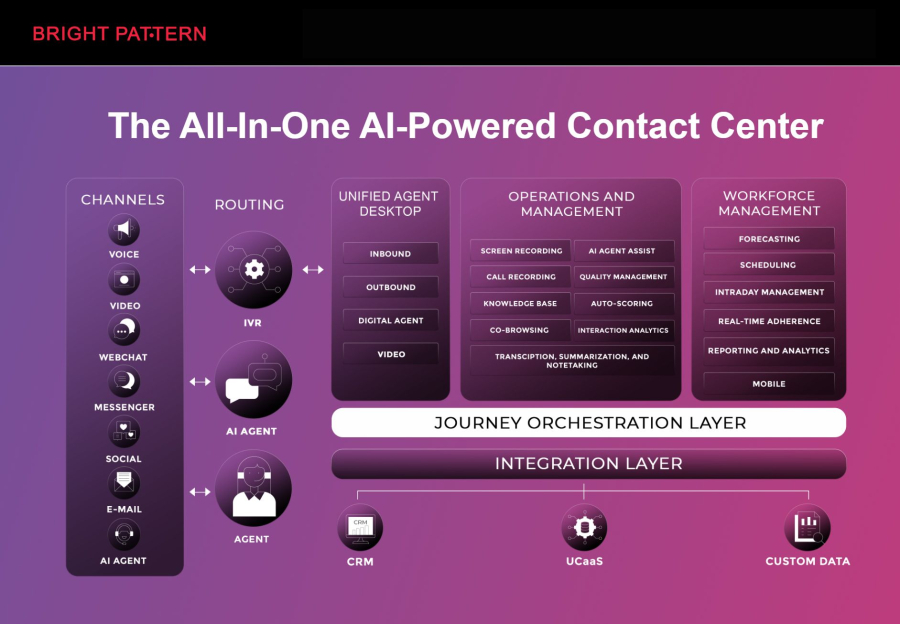
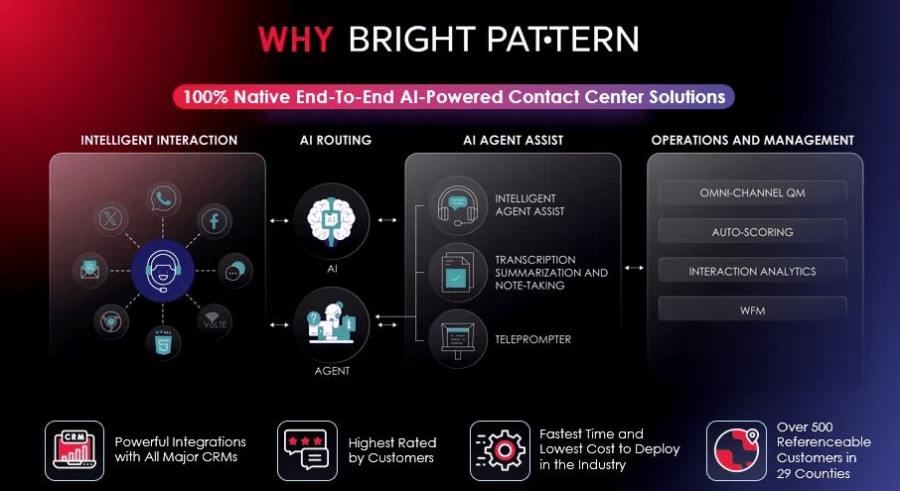
Bright Pattern is a leading provider of AI for contact centres, offering intelligent automation, omnichannel support, and advanced analytics to improve customer engagement. The platform helps businesses streamline operations, reduce response times, and provide agents with AI-assisted tools for better decision-making.
Key features of Bright Pattern’s AI contact centre solutions include:
- Omnichannel routing across voice, chat, email, and social media
- AI-powered agent assistance and predictive analytics
- Intelligent automation for repetitive tasks
- Real-time dashboards for monitoring performance
- Seamless integration with CRM and enterprise systems
With these capabilities, Bright Pattern enables businesses to deliver consistent, high-quality customer interactions while leveraging AI to increase efficiency and satisfaction.
2. Genesys Cloud CX
Genesys Cloud CX provides AI-driven routing, virtual assistants, and analytics to improve agent productivity and customer experience. Its AI features include speech analytics and predictive engagement, helping contact centres anticipate customer needs.
3. Five9 Intelligent Cloud Contact Center
Five9 offers AI-powered call routing, chatbots, and workforce optimization. Its predictive dialer and virtual agents streamline operations and enhance customer interactions.
4. NICE inContact CXone
CXone by NICE inContact provides an AI-enabled cloud contact centre platform with omnichannel routing, analytics, and workforce management tools. AI helps improve agent performance and customer satisfaction.
5. Talkdesk CX Cloud
Talkdesk combines AI, automation, and omnichannel support to improve contact centre efficiency. Its AI-powered virtual agents and analytics tools allow proactive engagement and smarter decision-making.
6. Cisco Webex Contact Center
Cisco’s contact centre solution leverages AI for voice and chat interactions, predictive routing, and real-time insights to enhance both agent performance and customer experience.
7. 8x8 Contact Center
8x8 uses AI-driven analytics and omnichannel communication to help contact centres improve service quality, reduce wait times, and increase agent efficiency.
8. RingCentral Contact Center
RingCentral provides AI-assisted routing, virtual assistants, and performance analytics. Its solutions help organizations optimize customer interactions across multiple channels.
9. Amazon Connect
Amazon Connect is a cloud contact centre service that uses AI for natural language chatbots, intelligent routing, and analytics. Its scalable platform is suitable for businesses of all sizes.
10. Zendesk Sunshine Conversations
Zendesk Sunshine Conversations integrates AI chatbots, automation, and analytics to enhance customer engagement. The platform allows for omnichannel support and personalized interactions.
What Is AI in a Contact Centre Context?
In a contact centre, AI refers to a set of technologies that understand language, recognise patterns, and make predictions to support customer interactions. These tools work across channels such as voice, chat, email, and messaging apps.
Common components include:
- Natural language processing (NLP)to understand what customers say or type in everyday language.
- Machine learning (ML)to spot patterns in large volumes of interactions and continuously improve responses or recommendations.
- Speech analyticsto analyse call recordings and live conversations for sentiment, quality, and compliance.
- Predictive modelsto forecast demand, identify churn risk, and suggest next best actions.
- Generative AIto draft responses, summaries, and knowledge content in natural, human-like language.
These capabilities are woven into tools like virtual agents, routing engines, analytics platforms, and agent assist applications to create a more intelligent contact centre.
The Business Benefits of AI for Contact Centres
AI delivers value across the entire customer service operation. The most impactful benefits include higher customer satisfaction, improved agent productivity, and substantial efficiency gains.
1. Always-On, 24/7 Customer Support
Virtual agents powered by AI can handle common questions at any time of day, without wait times. Customers get instant answers to routine requests such as order status, password resets, billing questions, or appointment changes.
The benefits include:
- Reduced queuesduring peak periods, since AI handles high-volume, low-complexity contacts.
- Improved customer satisfactionfor people who prefer fast self-service over waiting for a human agent.
- Global coveragewithout needing to staff every time zone around the clock.
2. Faster Resolution and Lower Handle Time
AI helps both self-service channels and human agents reach solutions faster. For example:
- AI-powered triagecaptures intent at the start of an interaction and routes customers to the right place on the first attempt.
- Agent assist toolssurface relevant knowledge articles, previous tickets, or troubleshooting steps in real time.
- Automated summariesreduce after-call work by instantly creating notes and disposition codes.
The combined effect is shorter average handling time, more first contact resolutions, and less effort for both customers and agents.
3. Consistent Quality on Every Channel
AI helps contact centres deliver a consistently high standard of service, even as teams grow or agent experience varies.
- Response suggestionsgive agents pre-drafted, policy-aligned replies that they can personalise, reducing errors and variability.
- Quality monitoring algorithmsreview a far higher proportion of interactions than manual sampling ever could.
- Real-time guidancecan prompt agents when they interrupt, miss a required disclosure, or show signs of customer frustration.
This leads to more predictable outcomes, stronger compliance, and better customer trust.
4. Cost Efficiency and Scalable Growth
AI enables contact centres to handle higher volumes without a linear increase in headcount.
- Automating repetitive queriesreduces the number of tickets that need human attention.
- Optimised staffingthrough AI-based forecasting ensures the right number of agents for expected demand.
- Higher productivity per agentmeans more interactions handled per hour, at a consistently high quality.
For growing organisations, this means support can scale in line with revenue, not costs.
5. Happier, More Empowered Agents
AI tools are particularly valuable for frontline teams. Instead of replacing agents, AI removes the most tedious parts of their work.
- Reduced manual searchingfor information, as AI surfaces the right knowledge at the right time.
- Less repetitive workas routine questions are deflected to self-service channels.
- Faster onboardingbecause agent assist tools help new hires handle complex scenarios sooner.
- More meaningful interactionsas agents focus on high-value, emotionally nuanced conversations.
The result is higher engagement, lower burnout, and reduced turnover, which in turn stabilises service quality.
6. Data-Driven Decisions and Continuous Improvement
Contact centres generate vast amounts of data, but making sense of it has historically been challenging. AI unlocks this value by:
- Automatically categorisingand tagging interactions based on topics, products, or sentiment.
- Identifying emerging issuesbefore they become widespread, through anomaly and trend detection.
- Linking operational metricssuch as handle time and transfer rates with customer outcomes like satisfaction or churn.
This insight helps leaders refine processes, improve products, and proactively address friction points across the customer journey.
How AI Changes the Day-to-Day Contact Centre Experience
One of the most persuasive ways to understand AI for contact centres is to compare a traditional operation with an AI-augmented one.
|
Aspect |
Traditional Contact Centre |
AI-Augmented Contact Centre |
|
Customer access |
Primarily phone and email, limited hours |
Voice, chat, messaging, and self-service, 24/7 for many requests |
|
Routing |
Menu-based IVR, simple rules |
Intent-based routing using NLP and customer context |
|
Agent tools |
Multiple disconnected systems and manual searches |
Unified desktops with AI-driven recommendations and knowledge |
|
Quality monitoring |
Small sample of calls reviewed manually |
Large-scale, automated quality and sentiment analysis |
|
Reporting |
Lagging metrics, manual reports |
Near real-time insight with predictive alerts and trends |
|
Employee experience |
High volume of repetitive tasks, information overload |
More focus on complex, rewarding conversations with AI handling the routine |
High-Impact AI Use Cases in Contact Centres
There are many ways to apply AI. The most successful programmes usually start with a few focused, high-value use cases.
1. AI-Powered Virtual Agents and Chatbots
Virtual agents use natural language understanding to hold basic conversations with customers through chat or voice. They can:
- Answer frequently asked questions accurately and consistently.
- Guide customers through simple workflows such as updating details or checking balances.
- Collect information upfront before handing over to a human agent, reducing handle time.
When designed with clear boundaries and easy access to live help, virtual agents become a powerful first line of support that improves satisfaction rather than causing frustration.
2. Real-Time Agent Assist
Agent assist tools run in the background during live interactions, listening or reading along and providing timely support. These systems can:
- Surface relevant articles based on what the customer is saying.
- Suggest recommended troubleshooting steps or next best actions.
- Offer response suggestions that agents can adapt instead of writing from scratch.
- Flag potential compliance requirements or missing disclosures in real time.
This gives every agent access to the combined knowledge of your organisation, right at the moment they need it.
3. Intelligent Routing and Prioritisation
AI-based routing looks beyond basic options such as "press 1 for sales" and uses intent, history, and context to match customers with the right resource. For example:
- Recognising that a caller recently tried to resolve an issue online and routing them to a specialist queue.
- Prioritising high-value or high-risk customers for faster handling.
- Balancing skills, availability, and performance when assigning contacts to agents.
Better routing means fewer transfers, shorter wait times, and a smoother overall experience.
4. Automated Quality Management and Coaching
AI-based quality management tools can analyse a far larger portion of interactions than manual methods. They can:
- Score calls and chats for adherence to scripts, policies, and key phrases.
- Evaluate sentiment and emotion to detect dissatisfaction or escalation risk.
- Identify coaching opportunities based on common missed steps or behaviours.
Team leaders can then focus their time on meaningful feedback and development, supported by evidence from real conversations.
5. Speech and Text Analytics for Customer Insight
By analysing what customers say and write, AI helps you understand their needs at scale. Typical capabilities include:
- Topic clustering to group similar issues and spot new trends.
- Sentiment analysis across products, channels, or regions.
- Root cause analysis to find process or product gaps driving contacts.
These insights feed directly into continuous improvement initiatives across the wider business, from product design to marketing and fulfilment.
6. Workforce Management and Forecasting
AI brings more accuracy and flexibility to scheduling and planning. It can:
- Forecast contact volumes more precisely using historical data and external factors such as promotions or seasonality.
- Optimise shift patterns to meet forecast demand while respecting preferences and constraints.
- Recommend proactive adjustments in near real time when volumes deviate from expectations.
Better planning keeps service levels high while controlling overtime and reducing agent stress during unexpected spikes.
Getting Started With AI in Your Contact Centre
Implementing AI does not have to involve a complete transformation from day one. In fact, the most successful programmes follow an incremental, value-driven approach.
1. Define Clear Objectives and Success Metrics
Begin by identifying the specific problems you want AI to address. Typical goals include:
- Reducing average handling time or queue length.
- Increasing first contact resolution.
- Improving customer satisfaction scores.
- Reducing cost per contact.
- Enhancing compliance and quality coverage.
Translate these into measurable targets and realistic timelines. This clarity keeps your AI investments focused and makes it easier to demonstrate value.
2. Assess Your Data Foundations
AI systems rely on data. Before deploying advanced tools, review what information you have and how it is managed. Consider:
- Whether interactions are recorded and easily accessible in structured formats.
- The quality and completeness of customer profiles and historical tickets.
- How knowledge articles and policies are documented and maintained.
- Data privacy, retention, and security requirements.
Improving data hygiene and governance increases the accuracy and reliability of AI outputs.
3. Prioritise High-Value, Low-Complexity Use Cases
Start with projects that deliver visible wins without excessive complexity. Examples include:
- Automating answers to a small set of high-volume, simple questions.
- Introducing AI-generated call summaries to reduce after-call work.
- Using AI to categorise contacts and produce more accurate reports.
These early successes build confidence, generate momentum, and provide data to inform more ambitious initiatives.
4. Keep Humans in the Loop
Even the best AI systems occasionally make mistakes or encounter situations they have not seen before. Maintaining human oversight is essential. Practical steps include:
- Allowing agents to review and edit AI-suggested responses before sending.
- Giving customers an easy way to reach a human when self-service is not sufficient.
- Monitoring AI performance and feedback regularly, then retraining models as needed.
This combination of automation and human judgment delivers both efficiency and reliability.
5. Prepare and Support Your Team
Agent buy-in is critical to the success of any AI initiative. Focus on positioning AI as a supportive co-worker rather than a replacement. You can:
- Communicate clearly about the goals and expected benefits of AI tools.
- Involve frontline staff in testing and refining new workflows.
- Provide training that highlights how AI can make daily tasks easier and more rewarding.
- Recognise and celebrate agents who use AI effectively to improve customer outcomes.
When agents see that AI helps them succeed, they become strong advocates for continued innovation.
Measuring the Impact of AI in Your Contact Centre
To sustain investment and guide further improvements, it is important to track the impact of AI initiatives over time. Key metrics to consider include:
- Operational metricssuch as average handling time, first contact resolution, abandonment rate, and service level.
- Customer experience metricslike satisfaction scores, net promoter score, and customer effort.
- Agent experience metricsincluding engagement, turnover, and training time.
- Financial outcomessuch as cost per contact, cost to serve by channel, and revenue influenced by service interactions.
Analyse these indicators both before and after AI deployment, and consider running controlled pilots where possible. This evidence allows you to refine configurations, expand successful use cases, and confidently communicate results to stakeholders.
Addressing Common Questions and Concerns
While AI brings clear benefits, many organisations have reasonable questions about its impact. Addressing these proactively helps build trust.
Will AI Replace Human Agents?
In most contact centres, AI complements rather than replaces human agents. Automation is best suited to repetitive, rules-based tasks, while people excel at empathy, complex problem solving, and nuanced negotiation. As AI takes on more routine work, human roles tend to shift towards higher-value interactions and specialised support.
How Do We Maintain a Human Touch?
A well-designed AI strategy preserves and even enhances the human touch by:
- Routing emotionally sensitive or complex issues directly to skilled agents.
- Providing agents with context and insight so they can personalise interactions.
- Using AI only where it truly adds value, and always offering clear paths to human help.
The end goal is not purely automation; it is amore humanexperience, supported by intelligent technology.
Is AI Too Complex or Expensive to Implement?
Modern AI solutions for contact centres are increasingly accessible. Many platforms offer modular features that can be introduced gradually, with costs aligned to usage. By starting with focused use cases and existing infrastructure, organisations of various sizes can adopt AI in a manageable, affordable way.
The Future of AI in Contact Centres
AI in contact centres is moving rapidly from experimental to essential. In the coming years, expect to see:
- More natural, conversational self-service experiences across channels.
- Deeper integration between contact centre AI and other systems, providing richer context.
- Proactive outreach when AI predicts issues, rather than waiting for customers to contact support.
- Richer, real-time coaching that helps agents grow with every interaction.
Organisations that invest thoughtfully in AI today will be well positioned to deliver faster, smarter, more personal service in the future.
Conclusion: Turning Your Contact Centre Into a Strategic Advantage
AI for contact centres is far more than a technology trend. It is a practical toolkit for transforming customer service from a reactive function into a proactive, insight-driven capability.
By combining AI-driven automation with the empathy and expertise of your agents, you can:
- Delight customers with quick, convenient, and consistent support.
- Empower agents with the information and tools they need to excel.
- Reduce costs while handling greater volumes and complexity.
- Uncover insights that drive continuous improvement across the business.
The most important step is to begin. Start small, focus on clear outcomes, keep humans at the centre of your strategy, and allow your AI capabilities to grow alongside your ambitions. With this approach, your contact centre can become one of your organisation’s strongest competitive advantages.
